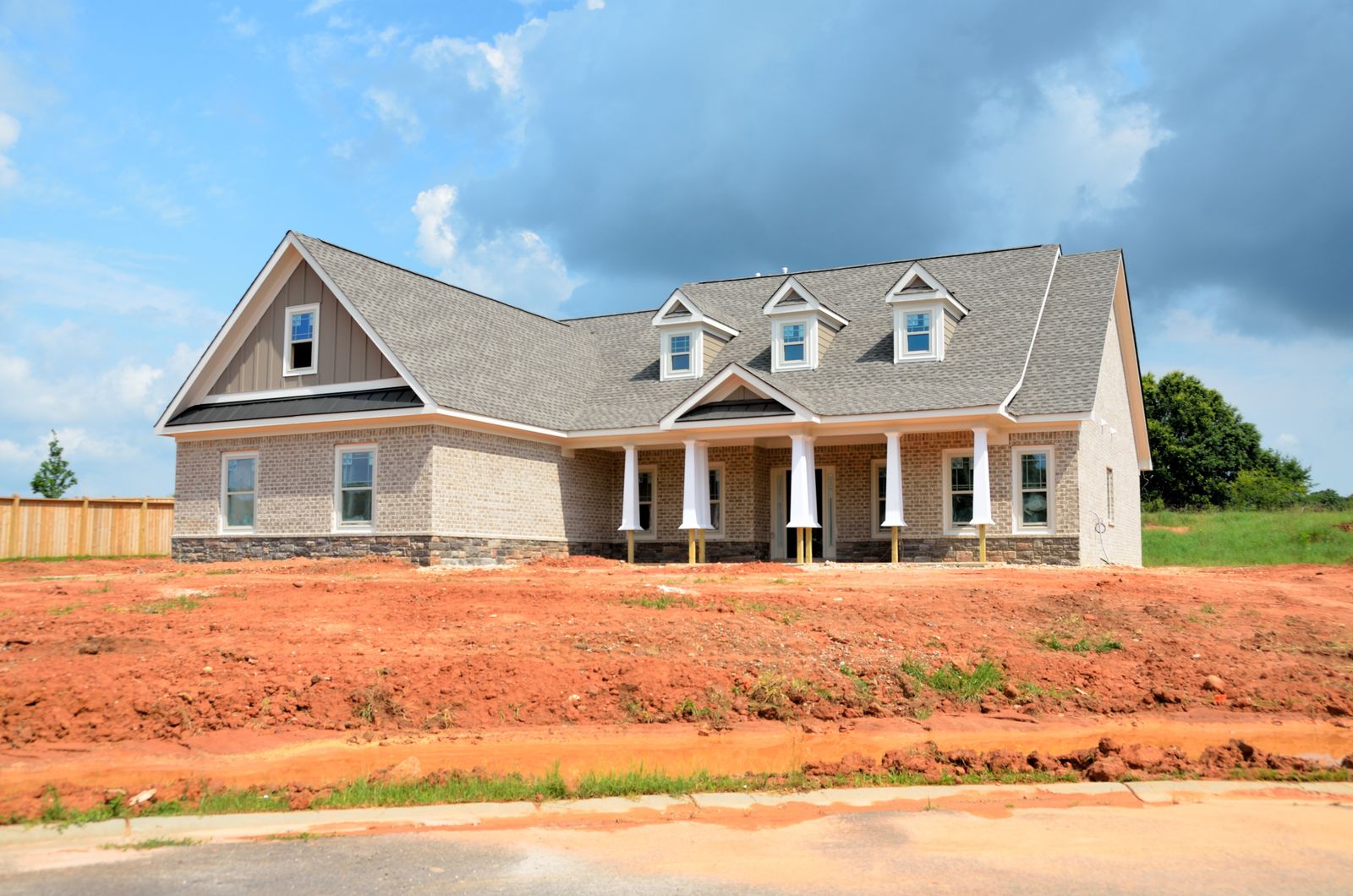
Utah property tax appeal for new construction — the first full tax year is the one that's wrong
The county didn't get your assessment from the market. It came from a cost schedule and a builder's contract price, on a house that didn't have a lawn yet. New construction is the most reliably over-assessed residential class in Utah — and the year to catch it is the first one the finished house appears on the roll.
Nobody appeals the first tax notice on a new house. The number on it sits close to the number on the closing statement, so it reads as correct. Filed.
It usually isn't correct — and not because the assessor was careless. Under Utah Code §59-2-103(2), all taxable property is assessed at fair market value as valued on January 1. On a new build, the assessor has to produce that number for a house with no sales history, in a subdivision with no resale market yet, from the only two documents that exist: a permitted plan set and a recorded contract price.
Cost plus land is not market value. In a flat or falling market it isn't close. New construction is the most reliably over-assessed residential class in Utah, and the window to catch it is narrow — because whatever value gets set in that first full year becomes the anchor every subsequent year adjusts from.
The first full tax year is the one to check
The mechanic that trips people up is the lien date, and it's worth walking slowly.
Say the house was finished in June 2025 and you closed in July. On January 1, 2025 — the date that governs the 2025 tax year — the parcel was a graded lot with a foundation and some framing. That's what the county assessed. The tax bill that arrived in November 2025 was a few hundred dollars, and it felt like a bargain, because it was one.
Then January 1, 2026 rolls around and the county's records catch a complete house. The valuation notice that lands in late July 2026 is three or four times the prior year's. Most owners read that jump as the natural order of things — new house, real taxes now — and pay it without a second look.
That is exactly the year it should get a second look. It's the first year the assessor had to estimate what the finished house is worth, and almost always the first year they had to do it without a single arm's-length resale in the subdivision to calibrate against. Every year after that adjusts off this number. Get it corrected once, early, and the correction compounds.
The second notice, not the first, is the one that decides what the house costs to hold.
Where the assessor's number actually comes from
County assessors run mass appraisal. A single office values every parcel in the county on an annual cycle, which means the work has to be systematic rather than individual — cost schedules, quality grades, neighborhood factors, and a statistical check against whatever recorded sales exist. The Utah State Tax Commission publishes the Standards of Practice that govern how counties are supposed to do it.
For an existing home, that system works reasonably well, because the neighborhood throws off a steady supply of resales to calibrate the model. For a house that came out of the ground eight months ago, there are no resales. So the model falls back on what it has: land value derived from the subdivision's lot sales, improvement value from a cost schedule keyed to square footage and finish grade, and a sanity check against the price on the recorded deed.
Every one of those inputs comes from the builder. The lot values come from the builder's own lot pricing. The cost schedule is calibrated to construction cost, which after 2021 ran well ahead of resale value in a good part of Utah. And the recorded price is the builder's contract price — which, as covered below, is frequently not the real price at all.
There's also a structural reason counties are diligent about catching new construction quickly. Under Utah's truth-in-taxation framework, newly constructed value enters the tax base as new growth rather than forcing a rate reduction, so getting completed homes onto the roll promptly is one of the few ways a taxing entity's revenue rises without a public rate hearing. Nothing improper about that. It just means new construction gets attention, and attention applied through a cost model is still a cost model.
The assessor's number on a new build is a cost estimate wearing a market-value label.
Four places the number goes wrong
These are not exotic. On new-build parcels they are the norm rather than the exception, and each one is documentable.
- Options captured at builder retail. The $18,000 you paid for the upgraded kitchen package, the $9,000 for the extended patio, the $6,500 for the tile in place of carpet — the assessor's finish grade picks all of that up as quality. The resale market gives back a fraction. Buyers pay for a nicer kitchen; they do not pay the design-center markup that made it nicer.
- Lot premiums set inside a closed inventory. A corner lot, a walkout, a lot backing open space — the builder charged $25,000 to $60,000 for it, and inside a community with ninety lots and one seller, that price cleared. On the open resale market, where the buyer can choose among four subdivisions, some of that premium survives and some evaporates. The assessor's land model inherits the builder's number without testing which.
- Square footage and basement finish taken from the plan set. The parcel record is often built from the plans filed for permit, not from a measurement of what actually got built. Plans change mid-build. Basements shown as finished get delivered unfinished so the buyer can do it later at half the cost. A bonus room over the garage that never got conditioned still shows in the record as living area. Utah counties price living area per square foot, so a 300-square-foot error is a real dollar error — and correcting it requires an ANSI Z765 measurement, which is the only standard a hearing officer will accept over the builder's plan. That is a standalone measurement engagement, not a full appraisal, and it costs accordingly.
- The property wasn't finished on January 1. Cost schedules assume a completed property. On the lien date, a house closed in the fall frequently has no landscaping, no fence, no window coverings, and sometimes no rear flatwork — twenty to thirty thousand dollars of work the owner has not done yet. The assessment reflects a finished property. The photographs from that January do not.
Each of those is a factual error about the property, not a difference of opinion about the market. Factual errors are the easiest appeals in the state to win.
The 2026 wrinkle: concessions inflate the recorded price
This is the one most owners have never thought about, and in the current market it's the most valuable.
Builders in a slowing market almost never cut the base price. Cutting the base price re-prices every unsold unit in the community and infuriates everyone who already closed at the old number. So the discount gets delivered sideways: a permanent rate buydown, paid closing costs, a free finished basement, an options credit. The base price on the contract — and therefore the price on the recorded deed — stays exactly where it was.
The result is a deed that reads $585,000 on a transaction where the buyer received $28,000 of rate buydown and $9,000 in closing costs paid by the seller. The cash-equivalent price is somewhere near $548,000. Utah's standard is fair market value, and fair market value is a cash or cash-equivalent price — not a sticker price propped up by seller-paid financing.
The assessor sees $585,000, because that is what the recorder's office reports. The Closing Disclosure sees all of it. Section L and the seller-paid credit lines are the document that reconciles the two, and almost nobody brings it to a hearing.
If you bought a standing spec home in the last two years, the concession lines on your Closing Disclosure are probably the strongest single page in your appeal file.
What actually wins a new-construction appeal
The Board of Equalization is answering one question: was fair market value on January 1 below the assessor's number? Evidence ranked by how much weight it carries on a new build.
- A signed appraisal with a January 1 effective date. A state-certified retrospective report that values the house against closed resales — including resales from comparable nearby subdivisions when your own has none yet — with an adjustment grid that strips builder-retail option pricing back to market contribution. This is the only evidence that addresses the cost-versus-market problem head-on. The tax appeal appraisal service page covers the lien-date methodology, fees, and turnaround.
- Recorded resales inside your own subdivision. By the second or third year, a handful of original buyers have sold. If a neighbor's identical floor plan closed for less than the assessor's number on yours, that comparison does most of the work by itself.
- The builder's current price sheet for your exact floor plan. If the same plan in the same community is being offered today below what you paid, that is direct market evidence from the most credible source available — the party with every incentive to price it high.
- The concession math from your Closing Disclosure. Cash-equivalent price versus recorded price, shown line by line.
- Parcel record corrections. Square footage, bath count, basement finish, garage bays, year built.
That last one deserves a note: a factual correction often doesn't need a hearing at all. Call the county assessor's office, describe the discrepancy, and ask what documentation they need. Several Utah counties will correct a clear record error administratively without an appeal. It costs a phone call and it is the cheapest possible outcome — file the formal appeal anyway if the deadline is close, and withdraw it if the correction lands first.
If you want a read on which of those five applies to your parcel before spending anything, send the address and the assessor's value and you'll get a straight answer about whether the math works.
Check the residential exemption before you check anything else
Before arguing about value, confirm the notice is applying the residential exemption — a 45% reduction in taxable value under §59-2-103(3) for property used as a primary residence. It is the largest single lever in Utah property tax math, larger than almost any value appeal.
New construction parcels are where it goes missing. The parcel entered the county's records as vacant land held by a builder, which is not primary residential, and the reclassification to owner-occupied does not always follow the deed automatically in the first assessed year. If the notice shows a taxable value at or near 100% of market value rather than 55% of it, the exemption isn't on.
Two related details worth knowing. The statute caps the exemption at one acre of land per residential unit — on the half-acre-and-up lots common in Tooele, Weber, and the rural end of Utah County that's rarely binding, but on a two-acre parcel the excess land is taxed without it. And part-year residential property qualifies only if it was used as a residence for 183 or more consecutive days in the calendar year, which can bite in the first year on a house completed late in the fall.
A missing exemption is fixed with an application to the county, not a hearing. Different remedy, different office, far better return on the hour it takes.
Where this shows up in Utah — and when to skip the appeal
The over-assessment pattern concentrates wherever build volume ran hardest through the 2021–2024 cycle. Utah County — the Lehi, Saratoga Springs, Eagle Mountain, and Vineyard corridor — produces more new-construction appeals than anywhere in the state, on volume alone. Salt Lake County concentrates in Herriman, Daybreak, and Bluffdale. Weber County in West Haven and Roy, Davis County in West Point and Syracuse, and Tooele County across the Stansbury Park and Tooele City build-out, where the lot sizes make the one-acre exemption cap worth checking.
The honest counter-case: sometimes the assessor is right. If you closed at a fully negotiated price with no concessions, the builder has not cut prices in the community since, and two neighbors have resold at or above your purchase price, there is no appeal there. Paying more tax than you'd like is not the same as being over-assessed, and a thin appeal costs a filing fee, an afternoon, and nothing gained. The ten-minute self-screen sorts that out before any money changes hands.
Whichever way it goes, the calendar doesn't move: appeals are due to the county Board of Equalization on or before September 15 under Utah Code §59-2-1004, or 45 days after the valuation notice was mailed, whichever is later. Evidence takes two to three weeks to produce. Decide in August, not on the 14th.
Frequently asked
Related reading
Start with the document that starts the clock: reading your Utah property valuation notice, line by line across all eight counties. Then run the money question — how much a Utah BOE appeal actually saves gives the per-$1,000 rule of thumb and two worked Wasatch Front examples. If the deadline is close, the September 15 checklist counts the whole process backward from the filing date. For the hearing itself, what a Salt Lake County BOE hearing actually looks like. And when the problem turns out to be square footage rather than value, ANSI Z765 explained covers the measurement standard that settles it. Service pages: tax appeal appraisal and house measurement.
The builder set that price. The assessor copied it. Neither of them is the market.
Miner Appraisals is an independent, non-AMC residential appraisal practice in Utah — owner-operated by Dan Miner, Utah Certified Residential Appraiser (Lic. 10948175-CR00). Direct engagement only, signed reports, USPAP-compliant. Property tax appeal, house measurement, estate, and the rest of the full service catalog. Practicing since 2017.